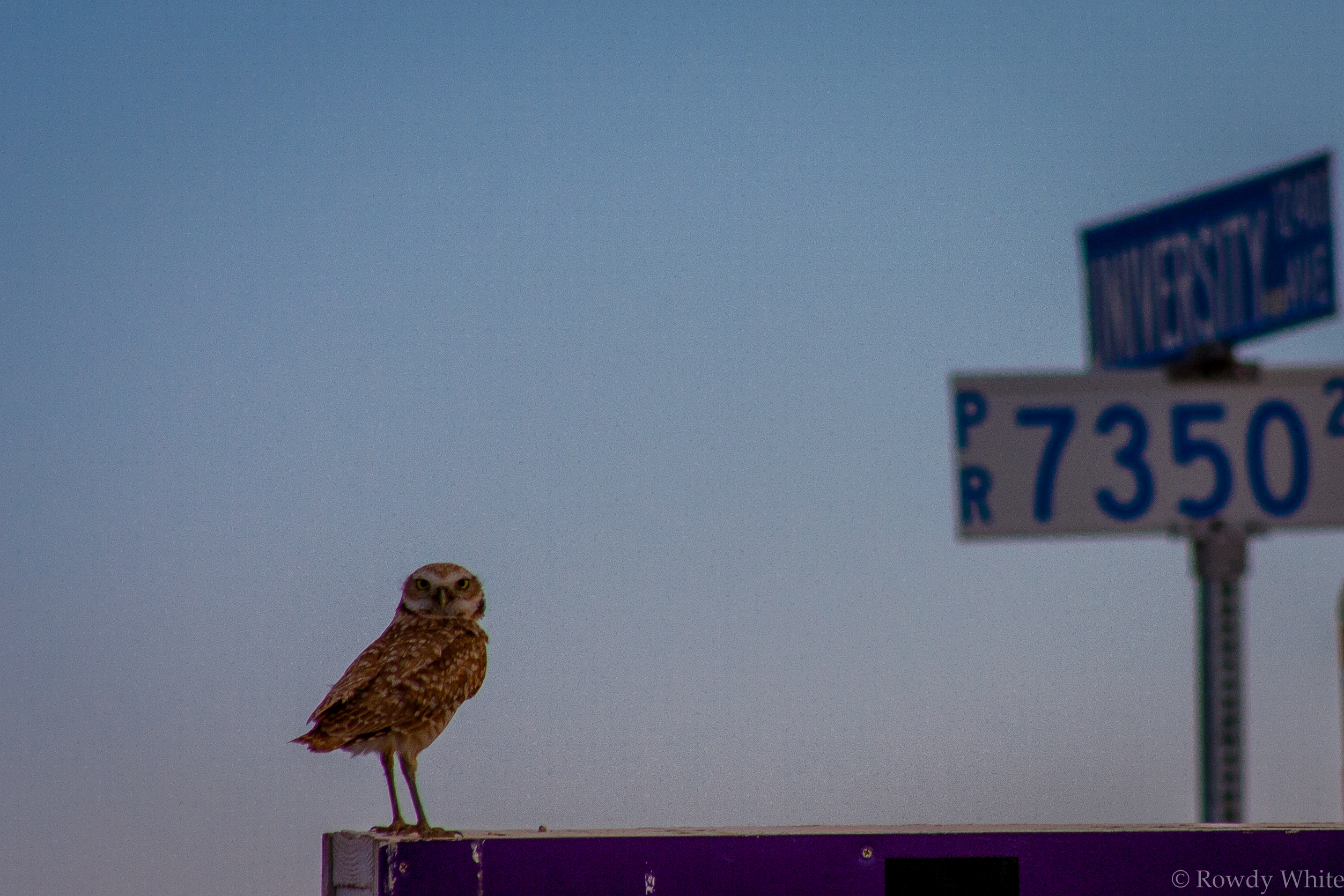
No longer a young man

II.

You rise in the dark in your rent house and turn off the air conditioner because you cannot abide the tyranny of noise in the morning. Greek yoghurt for breakfast to help you digestion, Ice in the water jug, a pickle in the lunch bucket, a naproxen for the chronic pain, and out to the truck to get to the field.

Later, sometime between false and real dawn, you lean against the bed of your work truck, enjoying the cool of the metal, looking up at Orion in the sky. An audiobook talks quietly from the phone in your pocket while you put together your telemetry equipment. As Orion fades away, you can begin to see the prairie surrounding you. Picking up a signal on the receiver, you start walking across the range. The signal is weak, so you hike up the canyon, homing in on the animal on which you put a radio collar months ago. As you walk, you see the plants, unconsciously naming them as you go. Helianthus, Ziziphus, curtipendula, Prosopis. Sunflower, lotebush, sideoats, mesquite. Where they are and how they are arranged tell you a story about the history of the place. You often think about how little you have changed while not realizing how many more names you have for your world, how much more the landscape tells you than it did before.  You reach where the canyon rises up to become the caprock, and the light on your equipment tells you the GPS data on your study animal has downloaded to your tablet. Another set of data points from which you’ll tell the world how prairie wildlife uses the landscape.

Since you are so close, you pick a deer trail and climb the escarpment, leaving the rolling plains for the llano estacado. By the time you reach the top, your sweat is salt and the wind hot and coarse across it. Catching your breath at the top, you look out across the dryland cotton that comes to the edge of the caprock. There’s Amaranthus along the edge and towards the field’s center. Amaranths. Pigweed. Carless weed. Wildlife food in a sea of fiber and ecological desert. Native and noxious. You wonder how many miles you walked chopping cotton back then compared to how many miles you hike doing wildlife biology now?

Some of those memories are blurry and faded, but you remember the sweat and the waiting and the want. How many rows walked, how miles of ditches dug, how many long nights working a job you hated to get from then to now? You’re unsure, but the math says it took you fifteen years longer to get to college than your classmates. You turn your back and mind to the cotton and past to use the high ground to scan through the other frequencies of your radio collars.

Eventually the first part of the day is over, and you load up in your work truck to head back to the office to analyze your data. The hours spent driving between study sites doesn’t bother you. You live in your head a lot of time, so for hours at a time you compose stories in your head, think about all the jobs you’ve had and the ones you still want, what life was like before college left you stranded in the gulf between your first social circle and what is supposed to be your current one. More and more you think about a tiny shack someplace quiet with no pressing need to be anywhere in the morning but on the porch watching the sun rise. You’re still waiting. For another house in the country, for a job with fewer hours, more time in a tent, less time being in charge. You’ve learned your patterns enough to know you feel more feral at certain times of the year. You no longer quit jobs for the sake of the going. So, you’ll shrug off the urge to go do something different. Back at the office you’ll pour yourself a glass of unsweetened tea, sit down and write what you’ve spent the past years learning. You’ll not stop waiting.

Not today at least.

As a young man

I.

You rise in the dark just as your trailer house room is becoming cool enough to sleep, the hot summer night breeze feeling cool on your sweat. As you fry an egg for breakfast, the radio says it is 84 degrees. Ice in the water jug, a pickle in the lunch bucket against the heat cramps, and out to the truck to pick up Luis.

Later, sometime between false and real dawn, you lean against the bed of your truck, enjoying the cool of the metal, looking up at Orion in the sky. Luis and Anthony talk quietly about sports while you just listen, trying to soak up the coolness from the truck, storing it for the day. Eventually, as Orion fades away, you can begin to see the cotton plants in the field. Picking an eyeful of rows, you take your hoe and begin walking across the field. Near the field edges you hoe up Johnson grass, but as you move to the middle of the field it is mostly careless weed. You don’t know that in the coming years you’ll have latin names for carless weed. You only know the farmer is paying you a quarter under minimum wage to walk up and down his field to kill it. A half mile later you are on the other end of the field, and you move down to pick up another eyeful of rows to tend on your way back up the field. The more rows you can cover, the fewer miles walked. By now, the sun is fully over the horizon and the little bit of cool on the breeze is gone. The wind is picking up, but you know it will feel hot and coarse across the salt on your skin.

This is how you spend the first part of the day, leaving footprints in the soft red dirt as you trudge back and forth across the field. You spend the day hoeing weeds, composing stories in your head, thinking about all the jobs you could have while watching the heat mirages and dust devils in the distance. You wonder how far you would get if you took the term “chopping cotton” literally and spent the day hoeing up the cotton plants instead of the weeds. It would be slow going; would Luis and Anthony only notice what you were doing because you were falling behind? How many rows could you kill before the famer drove by and noticed? Sometime just before lunch, a small dust devil swirls through, snatching the large straw hat from Luis’ head and throws it down the field towards you. Your legs are heavy and tired as you jog to get it.

Eventually the first part of the day is over, the three of you load up in your truck, and it is back into town for a midday nap. You eat cold fried chicken for lunch, and since the trailer house is too hot for rest, you rinse off with a cold shower and lay in the shade on the back porch to read and nap. A couple hours spent in other worlds gets your mind right. You get up to go to Polly’s for a glass of tea before going back out to the field for the late afternoon bout of cotton chopping.

At the restaurant, you wave to your farmer who is sitting in the corner with his tea and cronies while you sit there with Luis, drinking sweet tea, waiting for the rest of the day to start. You don’t realize it yet, but you are always waiting for something. For the weather to cool down. For the weather to warm up. For the next construction job to start. For the time to be right to go to college. For there to be a cool place to sleep. For life to start. You’re dragged out of waiting to hear the man paying you four dollars an hour under the table tell his cronies that a good Christian man always pays his fair share. Last week you heard him say he couldn’t understand how a man could stand to be on welfare, and he just wouldn’t do it, and it was a shame his tax dollars went to it.

. . .

The air conditioner in your truck was broken a decade before it was yours, so on the way back to the barn, you hold your hand out feeling the wind while you look over the fields rushing by. You notice Luis has taken a piece of old shoestring and tied it to his hat to save it from the wind. In the field, the sun has canted towards the west, and it is more difficult to get started than it was in the morning. You stretch your legs while leaning against the hot truck bed, grab the file to refresh the edge on your hoe, and then it is back to walking up and down the rows until there isn’t enough light to see. You don’t mind the walking so much. You also live in your head for a lot of the time, so for hours at a time even the boredom doesn’t drag you down too much. But you’re still waiting for something while you imagine what the country looked like before the prairie was plowed into contour lines. You still want to throw down your hoe and go somewhere else just for the sake of the going. Just as you truly lose the light, you get back in the truck to take Luis home. Another day and another forty dollars. Tomorrow is Friday, so you’ll present yourself at the back door —never the front door— of the farmhouse for the $200 due you for the week.

Sexing Roadrunners

Greater Roadrunner (Geococcyx californianus), Kent County, Texas, 2018.

It seems everyone has a lot of questions about roadrunners (Geococcyx californianus) lately, including how to determine sex. Many observant people have noted that some roadrunners have a colorful post-orbital apterium  (the patch behind the eye) while others do not. It was once thought possible to determine sex depending on the presence of white or blue in this area(PDF warning), but current research indicates this method to be unreliable. The only reliable field method to visually sex a living roadrunner is to take measurements of the bill length and width as well as measurements of the foot. Besides the ethical concerns of chasing down a bird just to satisfy your curiosity, as you might imagine, they are difficult to catch! While it is unfortunate Roadrunners do not display as visible sexual dimorphism as many other birds (think of the white coloration of a male bobwhite and the tan coloration of a female bobwhite), it is still fantastic to observe the little differences between individuals.

roadrunner
Roadrunner with colorful post-orbital apterium, Mitchell County, Texas 2016.
roadrunner-1-4
Less colorful post-orbital apterium, Dickens County, Texas, 2016.

Another often asked question is whether roadrunners impact northern bobwhite populations through predation. The reasoning is that roadrunners are very successful predators of small animals including rodents, lizards, snakes, and even other birds. Since quail chicks start life the size of a marble and spend the first few weeks of their lives smaller than a golf ball, it is easy to imagine roadrunners quickly taking a brood of bobwhites. It doesn’t help that northern bobwhite are a species that have suffered a huge population decline in the last century, and biologists, landowners, hunters, and nature lovers are desperately exploring the driving forces behind that decline. This has led to some too quickly pointing fingers, and roadrunners have been a victim in the past. The truth is that there is no evidence to support the claim that roadrunners are negatively driving bobwhite populations. A Texas Parks and Wildlife Department project (PDF warning) examined the stomach contents of 118 roadrunners and found two bobwhite chicks out of many prey items. In a landscape plagued with drought, unmanaged grazing, and abundant mammalian nest predators, there is a long list of more likely culprits.

So, what do they eat then?

Roadrunner with Texas spiny lizard meal or bride-gift, Jones County, Texas, 2019.

The shorter list would be what roadrunners will not eat. From insects to rodents, lizards, snakes, birds, and plants, they are adapted to survive in the sometimes food scarce American Southwest. In 1998, I observed a roadrunner kill several cliff swallows by laying as flat as possible near a building and suddenly making an explosive jump to snatch a diving swallow from the air. After each kill, the roadrunner would carry the dead swallow to the base of a fence post and then return to hunt again. Later, the roadrunner carried off all of the swallows to a location I could not observe.

In addition to hunting for food for themselves, food plays a large role in roadrunner courtship. Males attempting to woo a mate will bring her bride-gifts. If she accepts the gifts, the new couple with build a nest together, with the male bringing the female nest material. While both sexes will incubate and tend the nest, the male will often bring the female food while she sits on the nest. This is another reason why causal observers make over estimate the influence of Roadrunners on prey species populations: while it may appear a single roadrunner is a blood thirsty killing machine, it may in fact be feeding half a dozen other roadrunners.

I may eventually write a full species account for the roadrunner for this blog, but a fantastic resource to learn more is Dr. Martha Maxon’s wonderful natural history book, The Real Roadrunner (paid link). It is very approachable by general interest readers while maintaining scientifically accurate information.

Greater Roadrunner, King County, Texas, 2019.
Greater Roadrunner, Hall County, Texas, 2019. While roadrunners seem to select for shorter cover to hunt in, they blend wonderfully into the midgrass prairie grasses of the Rolling Plains of Texas.


(Cover photo: Dawson County, 2017).

This post contains Amazon Affiliate links. If you buy a book linked to in this post, I receive a small commission, which helps buy gas to collect the material for this blog. If you find a book you like, but do not wish to contribute to me, simply close the link, open your favorite book seller’s store front in a new browser and search for the book (or even better, go visit them in person). I would rather you find wonderful new information than have you skip buying a book if you are uncomfortable with the affiliate program.

Updated 2022.

Water battles of the past are the battles of the future

Last summer we examined how a mid-sized Texas city supplies water to its citizens. From what it takes to fill up a lake, to how the water flows through the city, to how progressive cities are reducing waste, we have followed water from the cloud to the lake to the tap to the drain and back to the lake. All that is lacking to you give you the full picture is to look at the future water issues of Abilene, Texas. While this may seem rather specific, Abilene is just an example of issues that affect most western cities of a certain size.

To fully illustrate the point, we need to consider how Abilene has found water in the past.

To save time, I have condense the timeline into a simple animation:
(you may prefer to click on the image and display it in its own window.)

Abilene-Texas-water

History of Abilene, Texas water supply from the 19th century into the future

In the past

  • 1897 Lytle Lake
  • 1918 Lake Abilene
  • 1927 Lake Kirby
  • 1937 Fort Phantom Hill Reservoir
  • 1952 Clear Fork of the Brazos and Deadman creek Diversion Dams
  • 1962 Hubbard Creek Reservoir
  • 2003 O.H Ivie pipeline 
  • 2015 Wastewater recycling to Fort Phantom

In the future

  • Possum Kingdom pipeline
  • Cedar Ridge Reservoir

Will it be enough?

Since my last posts concerning water issues, Fort Phantom Hill Reservoir became 98% full; however, el nino has wandered off to play elsewhere and that mean little girl, la nina, may soon be here to further dry things out. 2016 is already on record as the 11th most dry winter, and drought is starting to steal back into Texas.

During the time between the moist autumn and the soon to be dry spring, many people have quickly forgotten how bad it can get. The City of Abilene is proposing a water park and people are calling for completely ending watering restrictions. Do you think it is wise? Leave me a comment.

In an upcoming post I will look at droughts of the past and also explore exactly what a “normal” year of rainfall looks like.


Abilene Texas Cooper hawk

This immature Cooper’s hawk was seen in downtown Abilene, Texas last winter splashing in a puddle by the curb; however, they are usually more woodland birds. Some of Abilene’s older neighborhoods with larger trees would be a good place to look. Look (and listen) near bird feeders as these hawks are known to hunt them for feeding birds. While their call is fairly distinctive, you’ll more likely notice the cries of protest from the other birds in the area.

Like many other birds, the Cooper’s hawk looks drastically different when young as compared to adults. This can make identifying them rather tricky. This is especially true for this species, as they are very easily confused with a sharp-shinned hawk. While I highly recommend owning a field guide (or one of the many free apps ) don’t let identification intimidate you. Just get out and enjoy the nature in your neighborhood. “I don’t know” is a perfectly acceptable answer if someone asks you about what you are looking at!

When to look

While these hawks can be seen year-round in most of the United Sates, winter is a very good time to be on the look out for birds of prey in Texas. Many species pass through the Big Country during migration, and many winter here.

Just the facts

Cooper’s Hawk
Accipter cooperii

Length: 16.5 inches
Wingspan: 31 inches
Females larger than males
Look around the edges of wooded areas and older neighborhoods.

Remember, there is a lot of nature right outside your door if you take the time to look.

Cooper’s hawk- Explore your neighborhood